
About Course
Program Vision
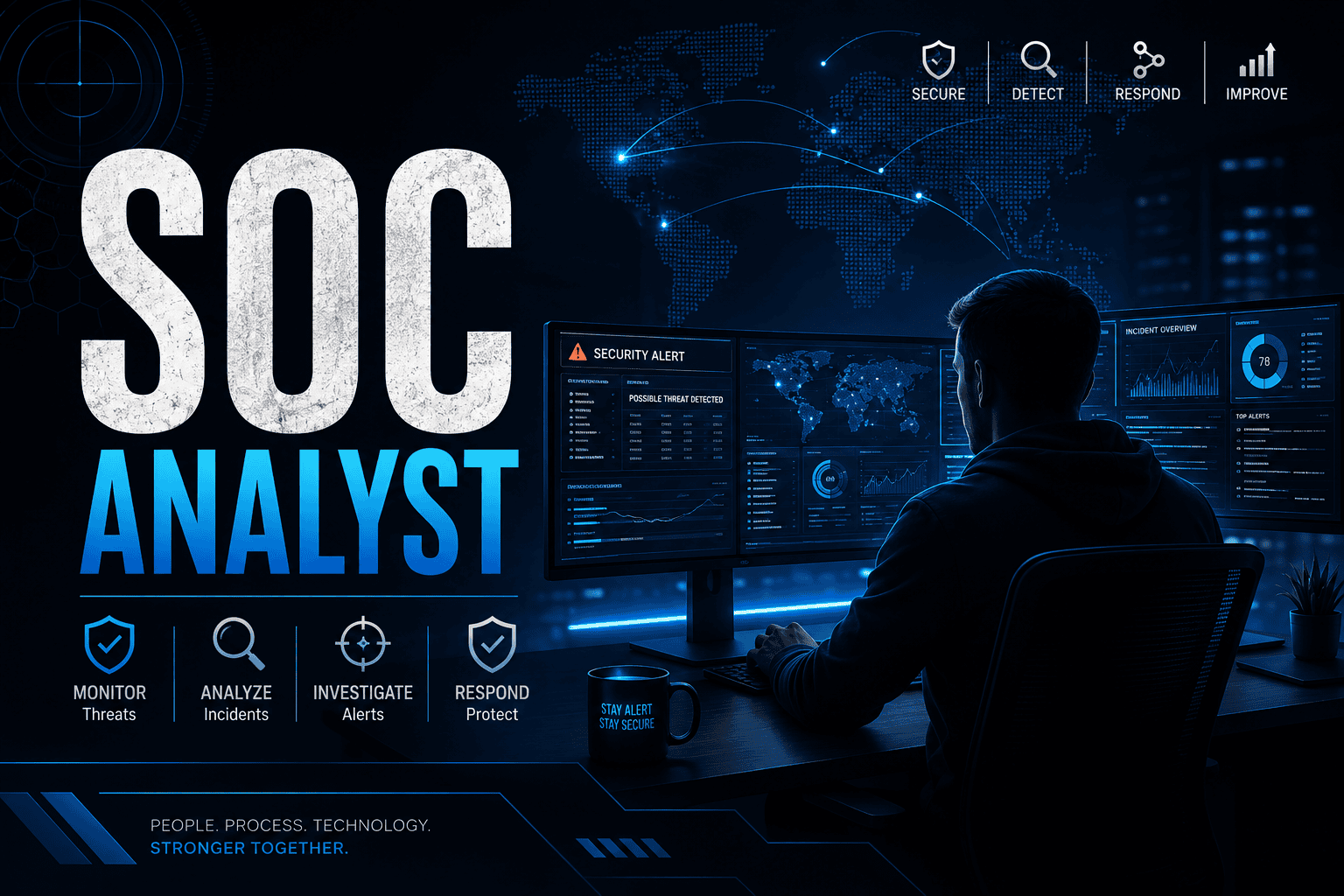
This curriculum is designed to take a learner with limited cybersecurity experience and progressively develop the knowledge, technical skills and investigation habits required for a junior SOC role. The sequence moves from IT and security foundations into telemetry, detection, triage, investigation, incident response and intermediate analyst skills.
Learning Journey
| PHASE | WEEKS | FOCUS | OUTPUT |
| 01 Foundations | 1–4 | IT, networking, security fundamentals | Explain core infrastructure and attack concepts |
| 02 Analyst Toolkit | 5–8 | Windows/Linux, logs, scripting, packet analysis | Collect and interpret security evidence |
| 03 SOC Operations | 9–14 | SIEM, alert triage, detection, email/identity | Investigate common SOC alerts |
| 04 Incident Response | 15–18 | IR lifecycle, containment, threat intel | Build evidence-driven incident cases |
| 05 Intermediate Skills | 19–22 | EDR, threat hunting, detection engineering | Hunt and improve detections |
| 06 Capstone | 23–24 | Integrated SOC simulation | Complete investigation + report + presentation |
- Program Outcomes
By the end of the program, a successful learner should be able to:
- Describe common enterprise architectures, network protocols, authentication concepts and security controls.
- Navigate Windows and Linux systems and identify security-relevant artifacts.
- Read and interpret common Windows, Linux, firewall, DNS, web, authentication and endpoint logs.
- Explain SIEM architecture, log ingestion, normalization, correlation, alerting and dashboards.
- Perform Tier-1/Tier-2 style alert triage using a repeatable investigation workflow.
- Investigate phishing, suspicious authentication, malware/EDR, network and endpoint alerts.
- Use basic query language and scripting to search, filter and enrich security data.
- Apply the incident-response lifecycle and document evidence, timeline, impact and recommended actions.
- Use threat intelligence and MITRE ATT&CK concepts to add context to investigations.
- Conduct introductory threat hunting and detection-engineering exercises.
- Communicate findings clearly in analyst notes, incident reports and escalation messages.
2. Prerequisites
No professional SOC experience is required. Recommended: basic computer literacy, willingness to use a command line, and basic familiarity with Windows. Networking fundamentals are taught from the beginning.
3. Assessment Model
| COMPONENT | WEIGHT | PURPOSE |
| Hands-on labs | 35% | Prove practical technical ability |
| Weekly quizzes | 15% | Check conceptual understanding |
| Investigation reports | 20% | Assess evidence-based analysis and communication |
| Practical checkpoints | 10% | Validate milestone skills |
| Capstone investigation | 20% | Integrated real-world-style assessment |
Course Content
Module 01 — IT & Cybersecurity Foundations
-
Security principles: CIA triad, authentication, authorization, accounting
-
Assets, vulnerabilities, threats, risk and security controls
-
Enterprise infrastructure: endpoints, servers, identity, cloud and network devices
-
Common attack surfaces and security terminology
-
Defensive security roles: SOC, IT, IR, threat hunting, detection engineering
Module 02 — Networking Fundamentals for SOC Analysts
Module 03 — Windows Security Fundamentals
Module 04 — Linux Fundamentals for SOC Analysts
Module 05 — Security Logs & Digital Evidence
Module 06 — SIEM Fundamentals
Module 07 — SOC Alert Triage & Investigation
Module 08 — Identity, Authentication & Cloud Security
Module 09 — Phishing & Email Security
Module 10 — Endpoint Detection & Response
Module 11 — Incident Response & Case Management
Module 12 — Threat Intelligence & MITRE ATT&CK
Module 13 — Threat Hunting Fundamentals
Module 14 — Detection Engineering & SIEM Rules
Module 15 — Automation, Scripting & Analyst Productivity
Module 16 — SOC Capstone & Professional Practice
Student Ratings & Reviews

No Review Yet